As rivers shrink and reservoirs hit historic lows, hydropower is quietly losing strength. The massive dams that once anchored grid stability now produce less electricity. Demand keeps rising — driven by heat waves and a rapidly electrifying economy. But decline isn’t the whole story. Sunlight is stepping in to fill the gap left by water. How the U.S. adapts will shape the grid’s future and the resilience of entire regions.
Drought Is Hitting Hydropower Hard
Prolonged drought, reduced snowpack, and shifting precipitation are dealing a direct blow to hydroelectric generation. Hydropower needs consistent water flow and adequate reservoir levels. When rivers run low or reservoirs drop below operational thresholds, output falls. Major systems across the West already face reduced capacity. Utilities scramble to lean on fossil fuels or other renewables to compensate.
The Numbers Tell a Stark Story
Power generation at Glen Canyon at Lake Powell fell by 17% on average from 2000 to 2023, compared with pre-drought years from 1988 to 1999. The basin has experienced its driest 22-year period in a 1,200-year record. In 2022, Lake Powell had dropped to historic lows, and power production was at its lowest since 1964, when production started.
The U.S. Energy Information Administration projects 2024 hydropower generation will fall roughly 13% below the 10-year average. Drought across the Pacific Northwest is the primary driver. A 2024 study in Nature Communications found capacity factors declined at approximately 80% of U.S. hydropower plants since 1980. That contributed to a cumulative generation drop of about 23%. The financial toll is equally stark. Research from the University of Alabama estimates drought-related losses between 2003 and 2020 cost utilities roughly $28 billion.
Variability Is the Deeper Problem
Reduced output is serious, but variability may be worse. Hydropower has long excelled at ramping up or down quickly to balance the grid. Unpredictable water availability destroys that reliability. This matters most during extreme heat events, when electricity demand peaks and the grid can least afford instability.
Solar Steps In Where Water Falls Short
Solar power doesn’t just offset declining hydropower — it complements it in ways few other sources can. Drought conditions that reduce river flow often coincide with clear skies and intense sunlight. This creates a natural substitution effect. When Southwest reservoirs are low and hydro output drops, solar production frequently peaks. Solar also excels at covering the afternoon demand surge — exactly the window hydropower has traditionally managed. By meeting daytime load, solar reduces the need to draw down scarce water reserves.
Storage Lets Solar Play Hydro’s Flexibility Role
Paired with battery storage, solar can replicate hydropower’s flexibility. Solar-plus-storage systems capture excess midday generation and release it after sunset. This mirrors the load-balancing function water-powered plants have historically provided. Without solar, hydropower shortfalls typically get filled by natural gas or coal — worsening the very climate conditions driving the water crisis.
The Science Backs It Up
Research increasingly confirms what grid operators already experience. A study in ScienceDirect found that integrating solar with existing hydropower boosted overall capacity by 25% while reducing reliance on hydro during low-water periods. A 2023 study in PNAS found that under extreme drought, fossil fuel plants may increase generation by up to 65% to compensate for lost hydropower. In heavily hydro-dependent states, drought-induced emissions could reach 40% of total electricity-sector emissions. Solar expansion directly counters that outcome.
Hydro and Solar Can Amplify Each Other
Research from Argonne National Laboratory points to an even tighter integration. Pumped-storage hydropower facilities — which accounted for 96% of U.S. utility-scale energy storage in 2022 — can absorb excess solar generation during low-demand periods. They store it as potential energy in elevated reservoirs, then release it when demand rises. In this model, solar and hydro don’t just coexist — they amplify each other. Studies show solar is especially well-suited to compensate for hydropower shortfalls during dry-season low-flow periods — precisely the conditions becoming more common across the American West.
Solar Scales Where Hydro Cannot
Solar projects build faster and across far more locations than large hydroelectric facilities. Dams are locked to specific geographies and dependent on water that’s increasingly scarce. That scalability makes solar one of the most practical near-term tools available as hydropower becomes less predictable.
A Bridge Over Drying Rivers
Solar won’t replace hydropower one-for-one. But it generates power when water is scarce, absorbs peak daytime demand, and pairs with storage to provide evening flexibility. Solar is uniquely positioned to stabilize the grid — and to bridge the widening gap left by America’s drying rivers.
By Frank Scotti, Sustainable Energy Advocate – Jun 16, 2026
Recent news coverage of a large commercial building fire in Los Angeles has understandably raised concerns among homeowners with rooftop solar. Images of flames involving a solar installation are alarming—especially when widely covered in the media.
But one critical fact often gets lost in the headlines: residential solar systems are extremely safe, and fires involving properly installed systems are extraordinarily rare. In fact, homes are significantly more likely to experience fires from common electrical issues—or even from a lightning strike—than from solar panels.
According to the U.S. Department of Energy, rooftop solar systems rarely cause fires. Most residential fires originate from conventional electrical sources and may spread to other parts of the home.
Built-In Safety Features
Modern solar systems are designed with multiple layers of protection, including:
Rapid shutdown technology
Arc-fault and ground-fault protection
Circuit breakers and disconnect switches
Continuous system monitoring
Required utility and building inspections
Certified, code-compliant equipment
These safeguards ensure that if an issue is detected, the system automatically shuts down before it can escalate.
The Importance of Proper Installation
As with any home electrical system, installation quality is critical. When solar-related incidents do occur, they are typically linked to:
Improper installation
Faulty connections or damaged wiring
Low-quality components
Poor workmanship or lack of maintenance
Choosing a licensed, experienced, and reputable contractor is the most important step in minimizing risk. A properly installed and maintained system presents a very low fire hazard.
How Solar Compares to Everyday Risks
Most homeowners rarely think about the electrical systems they use every day—outlets, appliances, HVAC systems, and aging wiring—all of which are common sources of residential fires.
A solar system is simply another electrical system, designed and inspected under strict safety standards. In fact, insurers and fire safety organizations generally do not consider solar to pose a higher fire risk than other properly installed electrical systems.
What Homeowners Should Do
If you already have solar:
Monitor system performance
Schedule periodic inspections
Respond promptly to alerts
Keep maintenance records
Use qualified professionals for service
If you’re considering solar:
Verify contractor licensing and insurance
Ask about safety features like rapid shutdown
Choose reputable equipment
Ensure permits and inspections are completed
Review warranties and certifications
The Bottom Line
Highly publicized incidents receive attention precisely because they are rare. A single event can create the impression of widespread risk, even when the data shows otherwise.
Modern residential solar systems have an excellent safety record. They are governed by strict electrical and fire codes and include multiple built-in protections for both homeowners and first responders.
The recent Los Angeles warehouse fire should not be viewed as representative of residential solar safety. Instead, it highlights the importance of proper design, professional installation, and ongoing maintenance—standards that have enabled millions of homeowners to safely benefit from solar energy.
For Central Coast homeowners, Solarponics has been designing and installing solar systems since 1975, with a long-standing commitment to safety, quality workmanship, and code-compliant installations. With thousands of systems installed and decades of experience navigating California’s strict standards, Solarponics customers can feel confident their systems are built for safe, reliable performance.
By Frank Scotti – Sustainable Energy Advocate – Apr 15, 2024
Small businesses are the backbone of economies worldwide, yet many are unaware of the significant advantages that come with reducing energy consumption and embracing sustainable practices. From cutting energy bills to accessing grants and incentives, the benefits are substantial and multifaceted.
One of the most compelling reasons for small businesses to reduce energy use is the substantial cost savings it can bring. Take, for example, a small retail store. By upgrading to energy-efficient LED lighting, they can reduce lighting energy consumption by up to 75%. For a store operating 12 hours a day, this could translate to savings of hundreds or even thousands of dollars annually on electricity bills. Similarly, replacing old, inefficient HVAC systems with energy-efficient models can result in significant savings on heating and cooling costs, often up to 20-30% reduction in energy usage.
Moreover, investing in energy-efficient equipment and technologies not only reduces operational expenses but also enhances the overall efficiency of small businesses. For instance, installing programmable thermostats allows businesses to regulate heating and cooling based on occupancy, reducing energy waste during non-operational hours. Similarly, investing in insulation and weatherization can improve building envelope efficiency, reducing the need for constant heating or cooling to maintain comfortable indoor temperatures.
Fortunately, there are various grants and incentives available at the local, regional, and national levels to help offset the initial costs of implementing energy-saving measures. Local utility companies often offer rebates for energy-efficient equipment upgrades, such as installing energy-efficient appliances or HVAC systems. Regional governments may provide low-interest loans or tax incentives for businesses that invest in renewable energy systems like solar panels or wind turbines. National programs, such as the Small Business Administration’s Energy Efficiency Loan Program, Property Assessed Clean Energy (PACE), or Rural Energy for America Program (REAP), offer financing and grant options specifically tailored to help small businesses implement energy-saving measures.
For instance, TECH Clean California is offering incentives of up to $4,800 to contractors across the state to support the installation of heat pump water heaters for commercial customers such as retail, businesses, office buildings, and schools.
Beyond the obvious energy and cost savings, embracing sustainability can open doors to new opportunities and markets. Many governments and larger corporations prioritize working with environmentally responsible partners, offering incentives, grants, and contracts to businesses that demonstrate a commitment to sustainability. By positioning themselves as eco-friendly suppliers or service providers, small businesses can access a broader network of clients and collaborators, boosting growth and profitability.
Small businesses that prioritize sustainability contribute to the greater good by reducing their environmental footprint. By conserving resources, minimizing pollution, and mitigating greenhouse gas emissions, they play a crucial role in combating climate change and preserving natural ecosystems for future generations.
Furthermore, by taking a proactive stance on sustainability, small businesses can inspire change within their own communities and industries. Whether through leading by example, educational outreach, participation in local initiatives, or advocacy for environmentally responsible policies, small businesses can catalyze broader shifts towards a more sustainable and resilient economy.
Ultimately, the benefits of small businesses reducing their energy use and embracing sustainability extend far beyond mere financial savings. By cutting energy bills, saving money, and addressing sustainable practices, small businesses can enhance their competitiveness, attract customers, and contribute to a healthier planet. In an increasingly interconnected world where environmental stewardship is paramount, embracing sustainability isn’t just good for business—it’s essential for long-term success and prosperity.
For better or for worse, the energy crisis of 1973 was pivotal in spurring interest in solar energy, creating a brand new industry and launching new companies and innovation. Solarponics is one of those companies. Founded in 1975, Solarponics is now California’s oldest, continuously operating solar energy company, celebrating its 50th anniversary this month.
What began as a small startup in San Luis Obispo installing solar thermal water heating systems has grown into a leader in whole-building sustainable energy and resource management. Today, the company, located in Atascadero, CA, designs and installs solar electric systems, heat pump water heating, heat pump pool heating, heat pump HVAC heating and cooling, EV charging stations, battery storage and backup systems, for residential and commercial projects on the central coast.
With a vision for a net-zero energy future on California’s central coast, Solarponics has made a lasting impact on the region’s environmental footprint. To date, more than 25,000 homes and businesses in San Luis Obispo County have gone solar, saving over $500,000,000, and reducing carbon dioxide emissions by an estimated 250,000 metric tons annually—the equivalent of planting 60 million trees.
San Luis Obispo County has also achieved a solar saturation rate of about 32% for single-family homes, far exceeding the national average of just over 7%, highlighting the areas commitment to quality of life.
Solarponics operates on a simple but powerful philosophy: Be kind. Live local. Work hard. Respect others. Make a positive difference every day. Over the past five decades, the company has remained true to its core and has contributed more than $500,000 to local organizations, reinforcing its commitment to make a positive difference.
Another point of pride is its 4.9-star customer satisfaction rating across all review sites. “We work tirelessly to deliver the best experience, and that means delivering reliable and proven performance over time,” said Frank Scotti, Solarponics CMO. “You don’t last 50 years without delivering what you promise and doing the right thing.”
This commitment is more than just words. For the seventh consecutive year, Solarponics has been recognized as a “Best of the Best” company by the national firm Best of the Best, which honors outstanding businesses based on licensing, accreditation, longevity, community involvement, customer reviews, responsiveness, and transparent leadership.
As demand for more and more energy continues to grow, so does Solarponics’ role in driving sustainable innovation. However, the road to net-zero electricity continues to be hindered by politically motivated legislation. Solarponics employees have made several road trips to San Francisco and Sacramento to lobby the CPUC for solar rights for homeowners. And while the industry has had some victories, legislation continues to favor oil, coal, and gas over sustainable energy.
The 30% investment tax credit that homeowners and businesses are eligible for when installing solar and battery backup ends on December 31 of this year, which is forecasted to significantly affect continued solar energy adoption. “Thankfully, energy rates continue to skyrocket, which makes solar a sound financial investment even without the tax credit here in California,” says Mr. Scotti. California has the second-highest energy rates in the country—just behind Hawaii, according to the U.S. Energy Information Administration[1].
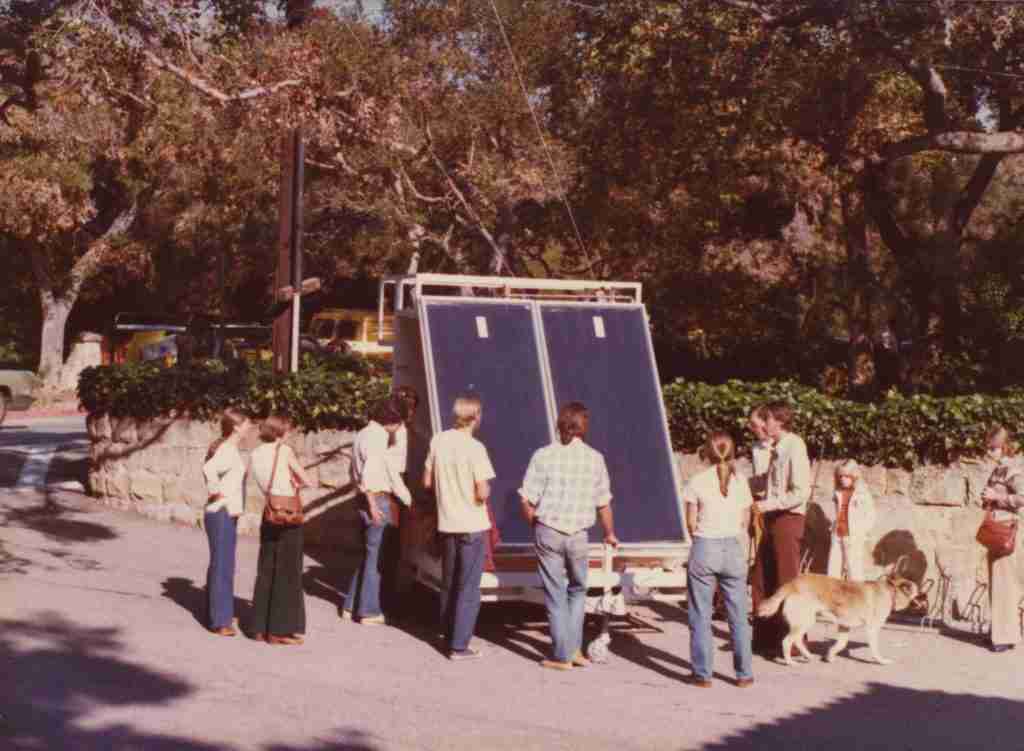
Solar Water Heating Display, Mission Plaza, San Luis Obispo, 1975
When asked about how the industry will cope with the loss of the tax credit, Mr. Scotti responds, “You’ll still save money with solar and battery, just not as much over time. And that’s what the utility companies want, to reel back in some of their losses. All we can do is continue to fight for consumer-friendly legislation, continue to pivot, continue to focus on other innovations that will help homeowners save energy and save money.”
Solarponics recently began installing heat pump HVAC systems—technology that is up to 60% more energy-efficient than traditional gas or electric systems. Solarponics also offers heat pump solutions for water heating and pool heating, further expanding its energy-efficient product portfolio.
With California targeting 100% zero-carbon electricity by 2045, and more than two million electric vehicles consuming 24 million kilowatt-hours of electricity daily, the need for cleaner, more efficient, easily scalable energy has never been greater.
“If I were to predict where we will be in ten years, I’d say this: Utility energy will cost over $1.00 per kWh, so we’ll still be installing solar and battery storage systems. Peer-to-peer energy trading—where one home sells excess solar to another—will be commonplace. Community-based grids will replace larger state-wide or regional grids. Battery storage will be made from safe, abundant, affordable sodium, and every home will have one. EV’s will integrate with homes, trading energy back and forth as needed. And California’s central coast communities will continue to lead the nation in sustainable energy and net-zero technology adoption,” says Mr. Scotti.


 Solar power doesn’t just offset declining hydropower — it complements it in ways few other sources can. Drought conditions that reduce river flow often coincide with clear skies and intense sunlight. This creates a natural substitution effect. When Southwest reservoirs are low and hydro output drops, solar production frequently peaks. Solar also excels at covering the afternoon demand surge — exactly the window hydropower has traditionally managed. By meeting daytime load, solar reduces the need to draw down scarce water reserves.