Long weekend, longer sunlight — and it turns out this has been a landmark year for solar in the United States. As we fire up the grill and enjoy the extra day off, it felt like the right moment to step back and look at just how far solar has come, and where it’s headed next.
We just crossed 6 million installations
Earlier this year, the U.S. officially surpassed 6 million solar installations nationwide — and 97% of those are sitting on residential rooftops just like the ones we install every week. What’s remarkable isn’t just the number, it’s the pace: the country went from 5 million to 6 million installations in only two years. For context, it took decades to hit that first million.
Right now, about 9% of U.S. homes have solar. By 2030, that’s expected to climb to 11%, with total installations projected to top 8 million. Solar isn’t a niche choice anymore — it’s becoming a mainstream part of how American homeowners power their lives.
The bigger energy picture
Zoom out to the utility scale, and the growth is even more striking. Cumulative utility-scale solar capacity has more than tripled since 2020 — from 48 gigawatts to 161 gigawatts by early this year. Just a decade ago, solar supplied less than 1% of U.S. electricity. Today, solar and battery storage together accounted for 91% of all new electricity-generating capacity added in the first quarter of 2026 alone, with solar on its own making up 60%.
That means more often than not, when the country adds new power to the grid, it’s coming from the sun.
A more complicated year for homeowners — and why that matters
We’ll be straight with you: 2026 hasn’t been a straight line up for residential solar. The federal residential tax credit (Section 25D) expired at the start of the year, and it caused a rush of installations at the end of 2025 as homeowners raced to lock it in — followed by a quieter stretch since. Industry-wide, residential installations are expected to dip this year before returning to growth in 2027.
Here’s the thing: the fundamentals that make solar worth it haven’t changed. Utility rates keep climbing, equipment keeps getting more efficient, and financing options — including third-party ownership and prepaid plans — are evolving to fill the gap left by the expired credit. If anything, a quieter market often means more attention, faster scheduling, and more room for us to walk you through what still makes sense for your home and budget.
Why Labor Day is a good day to think about solar
Labor Day marks the unofficial end of summer — peak sunlight, peak energy bills, and for a lot of homeowners, the moment they finally get around to that home project they’ve been putting off. If going solar has been on your mind, there’s no better time to get a straight answer on what it would look like for your roof, your usage, and your budget.
Enjoy the long weekend. And if you’re curious what solar could do for your home, we’re happy to run the numbers with you.
Sources: Solar Energy Industries Association (SEIA), Wood Mackenzie U.S. Solar Market Insight Report Q2 2026, American Clean Power Association Market Pulse Summer 2026.
For better or for worse, the energy crisis of 1973 was pivotal in spurring interest in solar energy, creating a brand new industry and launching new companies and innovation. Solarponics is one of those companies. Founded in 1975, Solarponics is now California’s oldest, continuously operating solar energy company, celebrating its 50th anniversary this month.
What began as a small startup in San Luis Obispo installing solar thermal water heating systems has grown into a leader in whole-building sustainable energy and resource management. Today, the company, located in Atascadero, CA, designs and installs solar electric systems, heat pump water heating, heat pump pool heating, heat pump HVAC heating and cooling, EV charging stations, battery storage and backup systems, for residential and commercial projects on the central coast.
With a vision for a net-zero energy future on California’s central coast, Solarponics has made a lasting impact on the region’s environmental footprint. To date, more than 25,000 homes and businesses in San Luis Obispo County have gone solar, saving over $500,000,000, and reducing carbon dioxide emissions by an estimated 250,000 metric tons annually—the equivalent of planting 60 million trees.
San Luis Obispo County has also achieved a solar saturation rate of about 32% for single-family homes, far exceeding the national average of just over 7%, highlighting the areas commitment to quality of life.
Solarponics operates on a simple but powerful philosophy: Be kind. Live local. Work hard. Respect others. Make a positive difference every day. Over the past five decades, the company has remained true to its core and has contributed more than $500,000 to local organizations, reinforcing its commitment to make a positive difference.
Another point of pride is its 4.9-star customer satisfaction rating across all review sites. “We work tirelessly to deliver the best experience, and that means delivering reliable and proven performance over time,” said Frank Scotti, Solarponics CMO. “You don’t last 50 years without delivering what you promise and doing the right thing.”
This commitment is more than just words. For the seventh consecutive year, Solarponics has been recognized as a “Best of the Best” company by the national firm Best of the Best, which honors outstanding businesses based on licensing, accreditation, longevity, community involvement, customer reviews, responsiveness, and transparent leadership.
As demand for more and more energy continues to grow, so does Solarponics’ role in driving sustainable innovation. However, the road to net-zero electricity continues to be hindered by politically motivated legislation. Solarponics employees have made several road trips to San Francisco and Sacramento to lobby the CPUC for solar rights for homeowners. And while the industry has had some victories, legislation continues to favor oil, coal, and gas over sustainable energy.
The 30% investment tax credit that homeowners and businesses are eligible for when installing solar and battery backup ends on December 31 of this year, which is forecasted to significantly affect continued solar energy adoption. “Thankfully, energy rates continue to skyrocket, which makes solar a sound financial investment even without the tax credit here in California,” says Mr. Scotti. California has the second-highest energy rates in the country—just behind Hawaii, according to the U.S. Energy Information Administration[1].
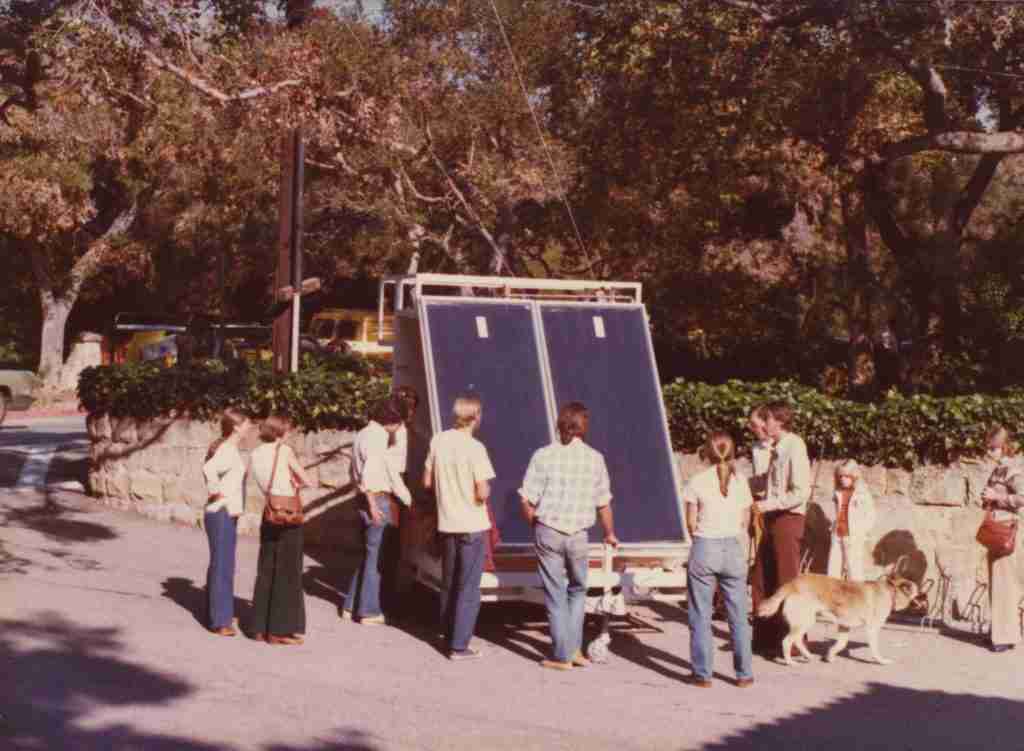
Solar Water Heating Display, Mission Plaza, San Luis Obispo, 1975
When asked about how the industry will cope with the loss of the tax credit, Mr. Scotti responds, “You’ll still save money with solar and battery, just not as much over time. And that’s what the utility companies want, to reel back in some of their losses. All we can do is continue to fight for consumer-friendly legislation, continue to pivot, continue to focus on other innovations that will help homeowners save energy and save money.”
Solarponics recently began installing heat pump HVAC systems—technology that is up to 60% more energy-efficient than traditional gas or electric systems. Solarponics also offers heat pump solutions for water heating and pool heating, further expanding its energy-efficient product portfolio.
With California targeting 100% zero-carbon electricity by 2045, and more than two million electric vehicles consuming 24 million kilowatt-hours of electricity daily, the need for cleaner, more efficient, easily scalable energy has never been greater.
“If I were to predict where we will be in ten years, I’d say this: Utility energy will cost over $1.00 per kWh, so we’ll still be installing solar and battery storage systems. Peer-to-peer energy trading—where one home sells excess solar to another—will be commonplace. Community-based grids will replace larger state-wide or regional grids. Battery storage will be made from safe, abundant, affordable sodium, and every home will have one. EV’s will integrate with homes, trading energy back and forth as needed. And California’s central coast communities will continue to lead the nation in sustainable energy and net-zero technology adoption,” says Mr. Scotti.